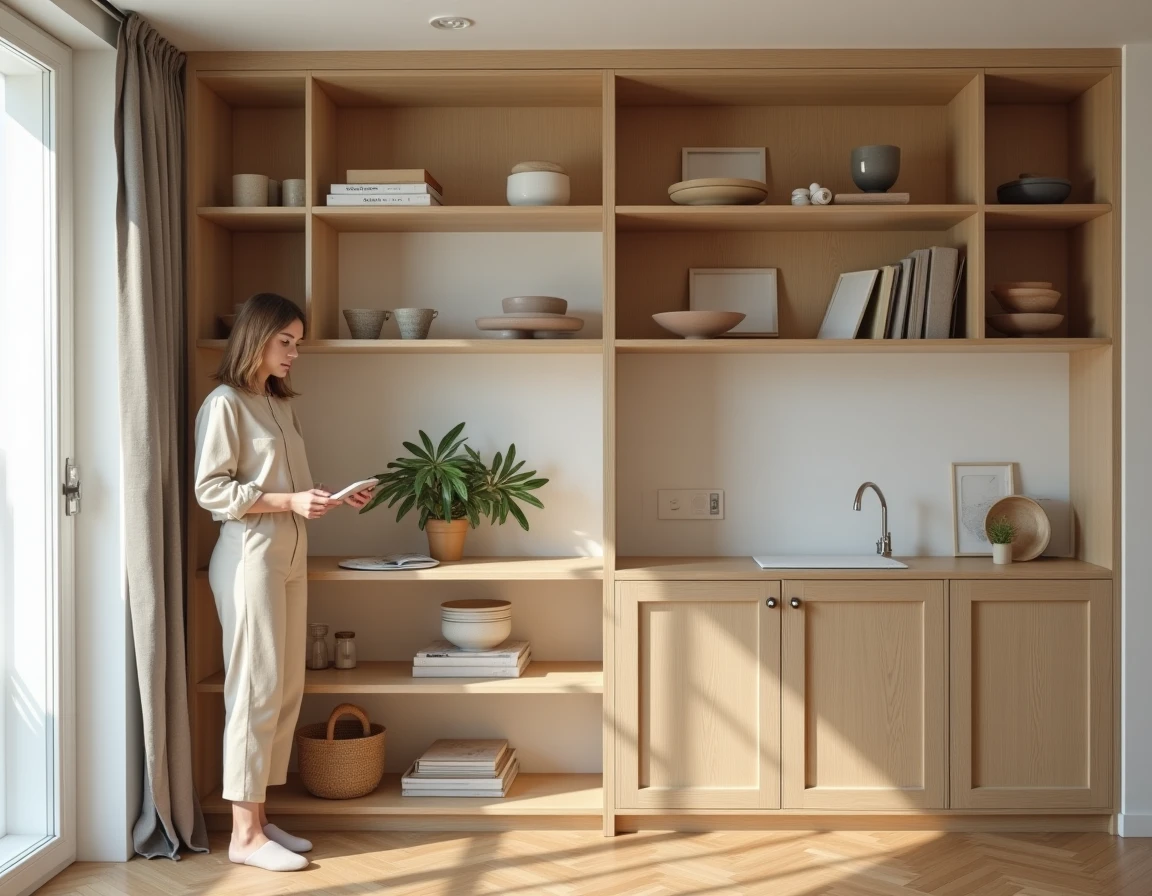
In small living spaces, standard furniture often leaves dead zones: unused corners, wasted ceiling heights, and recesses that are impossible to furnish. Custom furniture addresses this issue by adapting to the actual dimensions of a room, centimeter by centimeter. This approach is not merely decorative luxury; it stems from a technical constraint: when the living area falls below a certain threshold, every unused nook represents a measurable functional loss.
Custom Furniture and Energy Renovation: An Overlooked Tax Lever
Ademe and France Rénov indicate that certain custom installations integrated into the building may fall within the scope of energy renovation aid. The condition: these elements must directly contribute to the thermal improvement of the housing and be carried out by RGE-certified companies.
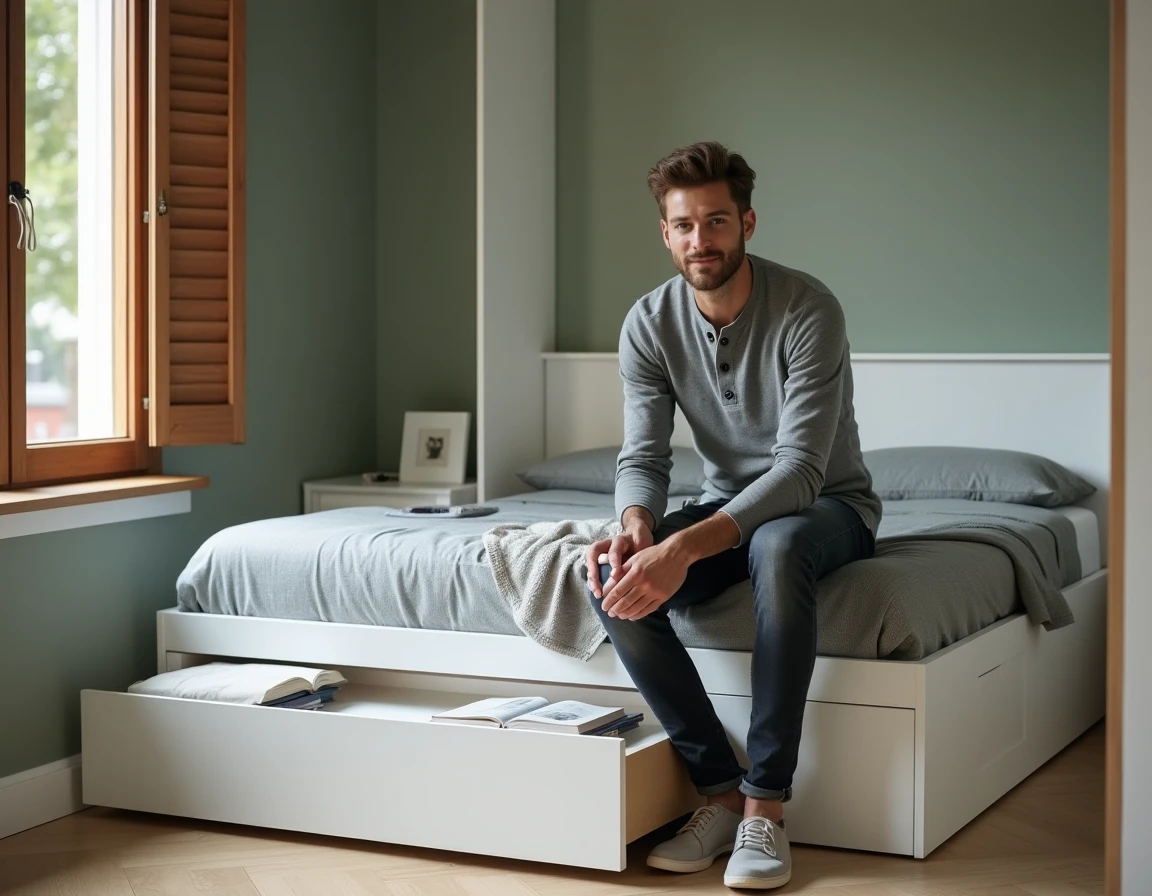
Specifically, an insulating partition with integrated storage or an insulated platform with storage space underneath can be counted among eligible expenses during a comprehensive renovation project (insulation + reconfiguration). This point changes the way integrated furniture is conceived in a small space.
Rather than simply placing a closet under sloped ceilings, a custom insulating box serves a dual purpose: it optimizes storage and contributes to the thermal performance of the envelope. For homeowners considering a custom furniture installation with Au Top, this tax dimension should be integrated from the design phase of the project.
Retractable Workstation: The Constraint of Remote Work in Less Than 25 m²
The generalization of remote work has created a need that standard furniture does not adequately cover: installing a functional desk in a living room that already serves as a living area, dining room, and sometimes bedroom. In small living spaces, the permanent coexistence of professional and domestic areas poses a real usability problem.
Several office furniture manufacturers (Haworth, Steelcase, among others) document a strong demand for foldable or sliding workstations designed to measure. The goal: for the desk to visually disappear outside of working hours.
The most advanced solutions combine several mechanisms:
- A retractable desk integrated into a storage unit, which folds behind a panel flush with the wall
- Rolling boxes slid under a custom bench, movable according to the time of day
- Closed niches with a sliding panel, sized to accommodate a monitor, keyboard, and documents without encroaching on the living room
This type of furniture requires precise measurements of the room. A gap of a few centimeters between the wall and the furniture is enough to render a retractable mechanism unusable. This is why these installations almost always fall under custom design.
Vertical Storage and Dead Zones: What Small Spaces Demand

The majority of compact homes suffer from the same deficit: walls are underutilized above one meter seventy. Standard furniture stops where a potentially considerable storage volume begins, between the top of a wardrobe and the ceiling.
A custom piece of furniture utilizes the entire available height, from floor to ceiling, without the empty band that collects dust at the top of a standard closet. In a narrow entryway, a storage unit running the full height of the wall can accommodate shoes, coats, vacuum cleaners, and suitcases without exceeding thirty centimeters in depth.
Dead zones represent another source of lost surface area. A wall recess, the space under a staircase, a cut-off section under the eaves: these areas, unusable with standard furniture, become functional as soon as a carpenter takes them on with appropriately sized dimensions. Custom under-stair storage recovers a volume that most residents leave empty for years.
Variable Depth According to the Room
A technical detail often overlooked: the depth of a storage unit does not need to be uniform. In a cramped bathroom, a unit fifteen centimeters deep is sufficient for everyday products. In a hallway, twenty centimeters can hold books or boxes. Custom design allows for this depth to be adjusted room by room, whereas standard furniture imposes its dimensions.
Custom Multifunctional Furniture: Bed, Table, and Storage in One Volume
The platform bed with integrated drawers remains the most documented example of multifunctional furniture suited for small spaces. Raising the bed by forty or fifty centimeters creates a storage volume equivalent to a whole dresser underneath, without occupying an extra centimeter of floor space.
A wall-mounted drop-leaf table frees up circulation when not in use. Paired with stackable or folding seating, it transforms a dining corner into a passageway in seconds. This principle also applies to a kitchen work surface in a home where the space dedicated to meal preparation is limited to a small linear area.
Field reports vary on the durability of inexpensive retractable mechanisms. The hinges, slides, and gas springs that equip these pieces of furniture endure daily use. A high-quality industrial mechanism costs more but avoids premature replacement, especially on a bed or desk that is manipulated several times a day.
- Quality gas springs withstand several tens of thousands of opening and closing cycles
- Full-extension slides allow access to the back of drawers under the platform without forcing
- Drop-leaf table hardware with locking in the open position prevents domestic accidents
The choice of hardware determines the longevity of the entire piece. A well-designed custom unit equipped with low-quality hardware will lose its functionality in a few years.
Optimizing a small space with custom furniture is not just a matter of aesthetics or decor trends. It is a technical response to precise dimensional constraints, which gains relevance when it integrates thermal, tax, and mechanical aspects of the project from the outset.