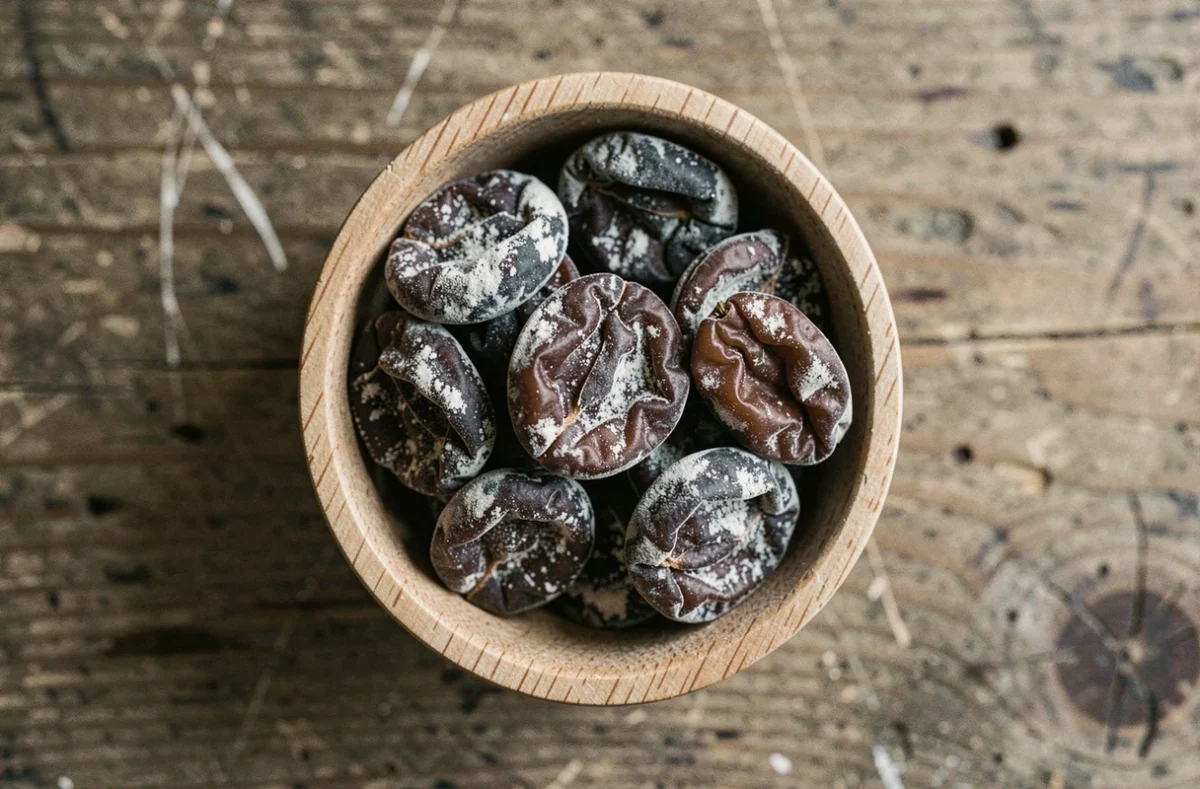
A bag of prunes is found at the back of the cupboard, and the date is several months past. The usual reflex: smell, look, taste with the tip of the tongue. This intuitive approach has its limits because the real problems associated with expired dried fruits are not always detectable by the naked eye or nose.
DDM and DLC on prunes: a confusion that changes everything
Most commercially available prunes carry a minimum durability date (DDM), preceded by the phrase “best before.” This date does not have the same significance as a consumption deadline (DLC), which is reserved for perishable products like meat or milk.
In practical terms, exceeding the DDM means that the manufacturer no longer guarantees the taste and nutritional qualities of the product. The prune may lose its softness, flavor, and vitamin content. However, it does not automatically become toxic.
The confusion between DDM and DLC leads to two opposite mistakes. Some throw away perfectly consumable prunes, contributing to food waste. Others, accustomed to exceeding the DDM without consequence, apply the same logic to products under DLC, posing a real health risk. When questioning the risks associated with expired prunes, the first step is to check which of these two dates is on the packaging.
Mycotoxins in expired prunes: an invisible danger
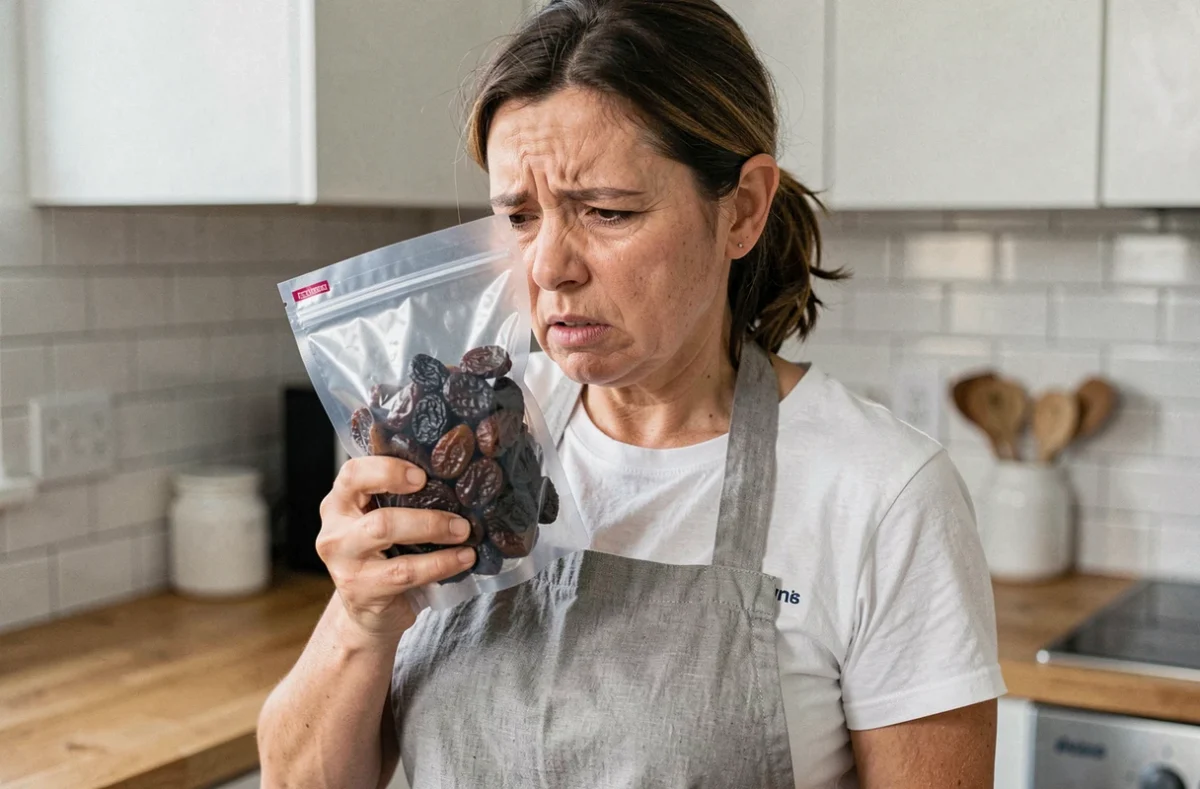
The most underestimated risk with prunes stored too long comes not from bacteria, but from mold, and more specifically from the mycotoxins they can produce.
A visible mold on a prune prompts immediate disposal. The problem is that some mycotoxins form without any visible trace. According to a synthesis published by Platzer et al. in Springer (September 2026), contamination by mycotoxins depends on humidity, temperature, and storage conditions. Anses confirms that the presence or absence of mold to the naked eye is not a reliable criterion.
In practice, a bag of prunes that has been opened and then poorly resealed, stored in a humid cupboard for several months after the DDM, creates favorable conditions for this type of contamination. Mycotoxins are heat-resistant and do not disappear during cooking, contrary to what one might assume when preparing a cake or compote with old prunes.
Storage conditions that accelerate the risk
The prune is a dried fruit with low water activity, which normally limits bacterial growth. But this protection has a limit: the uptake of moisture reactivates dormant microorganisms.
- An opened bag in a kitchen exposed to cooking steam gradually absorbs ambient moisture, creating an environment conducive to mold.
- Storage near a heat source (oven, radiator) accelerates the degradation of fats and sugars, producing compounds with a rancid taste.
- A non-airtight container allows insects and dust to enter, vectors of cross-contamination.
After opening, transferring the prunes to an airtight jar and placing them in the refrigerator significantly extends their consumption period beyond the DDM.
Concrete symptoms after consuming expired prunes
The majority of people who eat prunes a few weeks after the DDM feel nothing. Feedback varies on this point, and tolerance depends on the actual condition of the product and individual digestive sensitivity.
When a problem occurs, it usually manifests as gastrointestinal disturbances: nausea, abdominal cramps, diarrhea. These symptoms appear within hours of ingestion and often resolve on their own.
The more concerning scenario involves repeated exposure to low doses of mycotoxins over a long period. This type of chronic exposure does not cause immediate acute symptoms, making it difficult to detect. The most vulnerable populations (children, the elderly, immunocompromised individuals) exhibit increased sensitivity.
Expired prunes: the right reflexes before consuming or throwing away
Rather than a binary rule (“edible” or “to throw away”), a quick verification checklist can be applied:
- Check the type of date on the packaging: a DDM that is a few weeks past with an intact and well-stored bag rarely poses a problem. An exceeded DLC requires disposal.
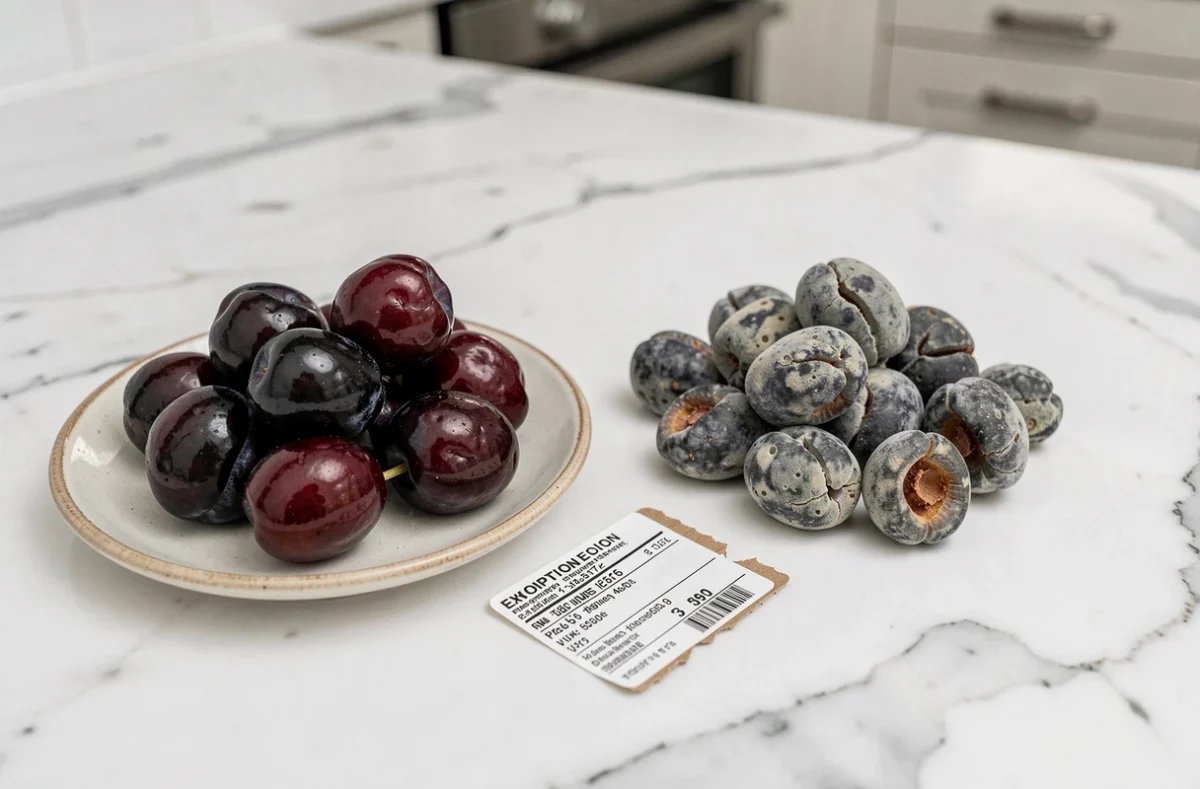
- Examine the appearance: any trace of mold, even sporadic, disqualifies the entire lot (mycotoxins spread beyond the visible area).
- Smell the product: a sour, fermented, or rancid odor indicates advanced spoilage.
- Evaluate the texture: a prune that has become very hard has simply lost its water. A prune that has become sticky or oozing indicates suspicious moisture uptake.
A hard prune with no abnormal odor is generally still consumable, even if it has lost some of its nutritional and taste qualities. It can be rehydrated in warm water or incorporated into a cooked preparation.
Nutrition: what degrades over time
Beyond food safety, nutritional value changes. The fibers, the main asset of the prune, remain relatively stable. However, vitamins, particularly vitamin C, gradually degrade after the DDM. Antioxidants follow the same trend.
The sugar content, on the other hand, does not decrease. An old prune remains an energy food, but with a nutritional profile impoverished compared to a fresh product.
Keeping prunes for several months after the DDM in an airtight jar in the refrigerator remains a reasonable option to limit waste. Storing an opened bag in a humid cupboard for the same duration, however, amounts to betting on the absence of contamination without any means of verifying it.