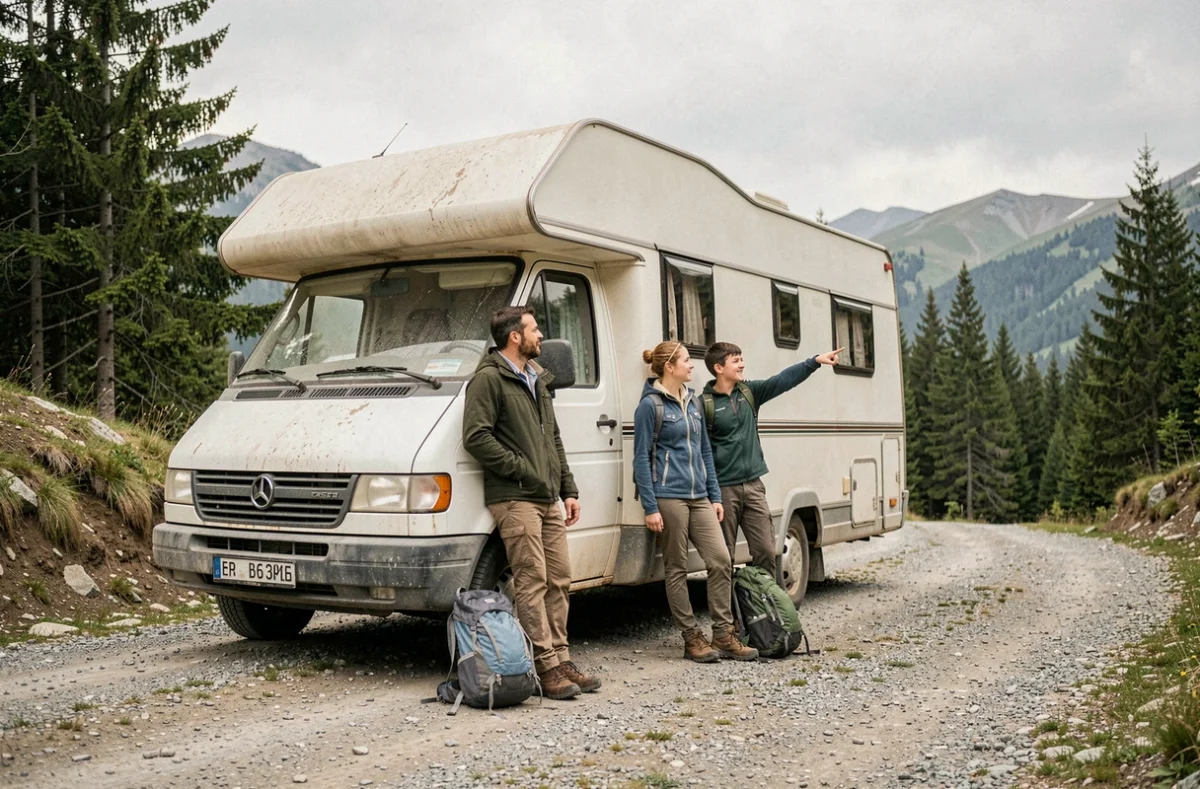
Going on a van trip with children means accepting to live in a few square meters for several days. Comfort depends less on the vehicle itself than on the preparation beforehand and the habits established from the first hours on the road. Traveling as a family in a van requires concrete choices regarding sleeping arrangements, storage, and the pace of stops, long before turning the ignition key.
Car seats and certification: the technical point that families overlook
Before dreaming of an itinerary, check one simple thing: the number of approved seating places in the van. A converted van may offer a large living space without having anchor points for car seats in the back.
Car seats or boosters must be secured on seats equipped with three-point seat belts and, ideally, Isofix attachments. On some models of converted vans, the rear benches only offer lap belts, which are incompatible with most child seats.
Have you noticed that rental companies do not always mention this detail? Ask the question before booking. A spacious van with only two real approved rear seats will not be suitable for a family of four. This point conditions everything else: there is no point in planning a van vacation if the children cannot travel safely.
Platforms like rouletitine.fr allow you to compare available vehicles and filter by interior configuration, which avoids unpleasant surprises at the time of pickup.
Storage in a van with children: every item has its place or chaos sets in
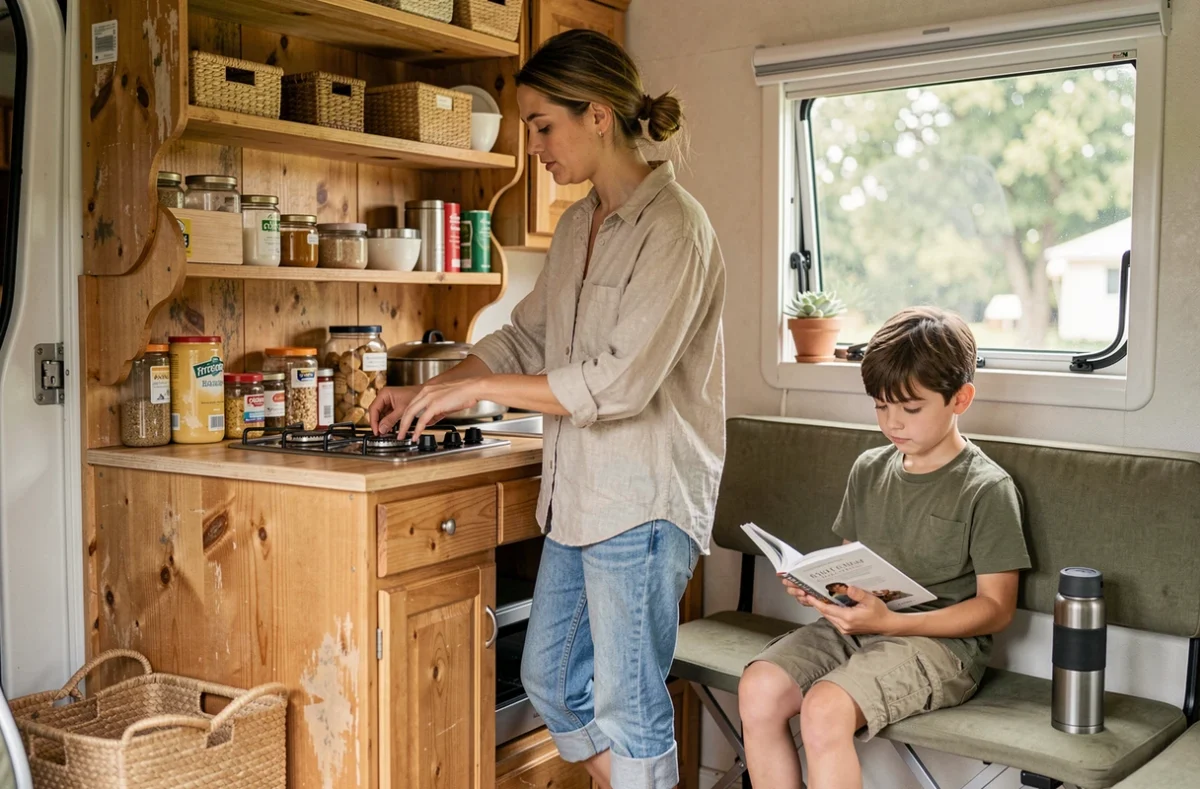
In a converted van, storage space is limited and shared between the kitchen, clothes, sleeping gear, and children’s belongings. The temptation is to bring everything. The result, after two days, is a van where no one can find anything.
The principle of assigned bags
Assign one soft bag per person, of the same size, that fits into a specific compartment. One bag per child simplifies the daily routine: everyone knows where to look for their things, and evening tidying takes just a few minutes.
Add a common bag for the kitchen (spices, cutlery, dish towels) and another for dirty laundry. Rigid bags or hard-shell suitcases should be avoided: they do not fit the shapes of van trunks.
Games and activities: limit to choose better
Bringing an entire box of toys is counterproductive. Select a few compact and versatile games:
- A family card game that works from four or five years old, also usable on rainy days under the awning
- Coloring books and a few markers stored in a zippered pouch, easy to take out during breaks
- A tablet loaded with downloaded content, reserved for long highway trips when fatigue sets in
Three well-chosen activities occupy children better than ten random toys. Children eventually invent their own games with what they find outside, as long as they are given free time without a schedule.
Short stops and parking in a van: what the regulations say
With children, trips longer than two hours become exhausting for everyone. Breaking the journey into short stages with stops in parks, at rest areas, or near a lake turns the trip into part of the adventure.
But where to stop for the night? Many families confuse parking and camping. Parking a van without setting up external equipment is not the same as establishing a campsite. Unfolding a table, placing chairs, or rolling out an awning can change the situation: municipal regulations govern these practices and vary from one municipality to another.
Before each overnight stop, check local signs and consult apps dedicated to campervan sites. Some free areas accept vans, while others are reserved for motorhomes with parking permits. A family with children should prefer equipped areas with water points and sanitary facilities, especially for the first trips.
Low emission zones and Crit’Air sticker: anticipate before an urban stop
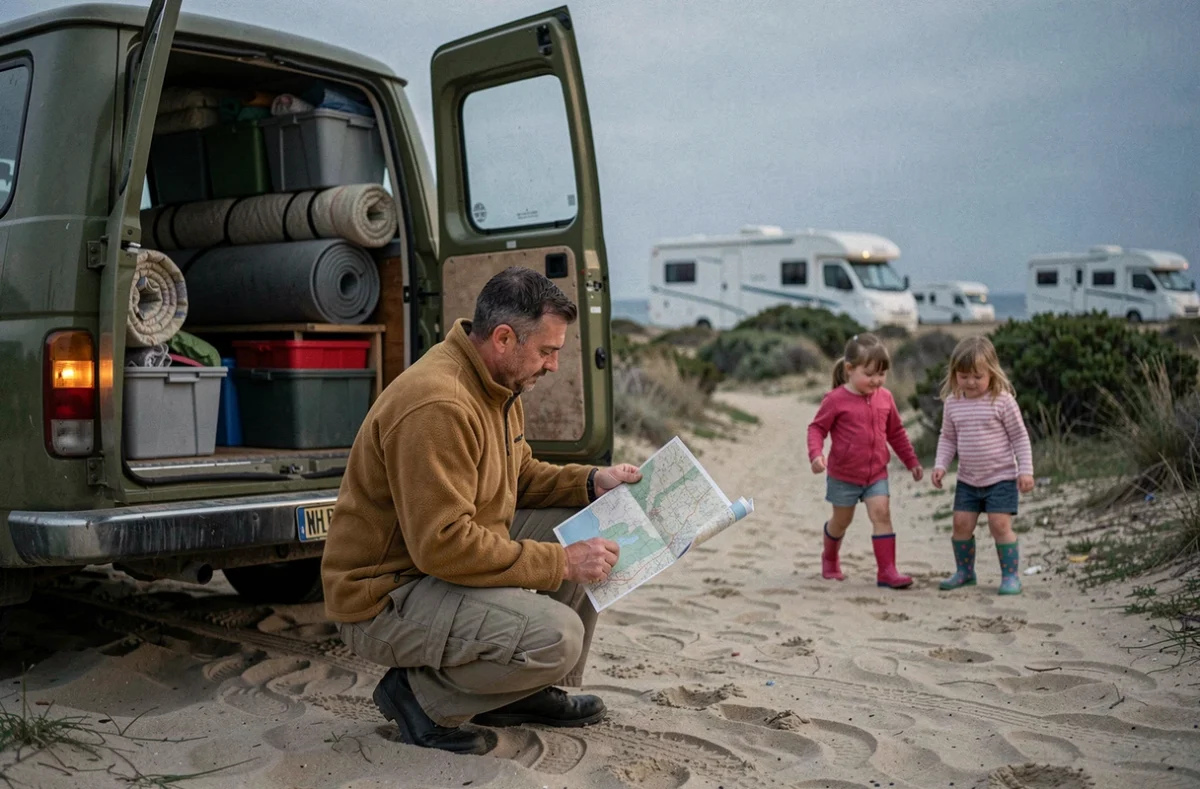
If your itinerary passes through a large city, one detail can complicate the day: low emission zones (LEZ). The Crit’Air classification of the van determines whether it can circulate in the affected area, and restrictions vary according to the community and the type of vehicle.
A converted van is not always classified as a passenger car. Depending on its maximum authorized weight and its administrative category, it may fall under a different regime. Check the registration certificate and order the Crit’Air sticker before departure.
In case of a pollution peak, temporary restrictions may be added to the usual LEZ rules. For a family planning to visit a city center with children, it is better to check the day before the stop that the van is allowed to enter the zone.
The family rhythm in a van: accept to slow down
The classic trap of a family road trip is wanting to see everything. An overly packed schedule generates fatigue in children and frustration in parents. Two activities per day are more than enough with children under eight years old.
Plan days without travel, where the van stays parked and the family explores the surroundings on foot. These “fixed base” days allow children to settle down, play freely, and give parents a breather.
The van imposes a different relationship with time than a hotel or rental. In the morning, everyone gets ready in the same space. In the evening, the sleeping arrangements are set up in a few minutes. These repeated rituals structure the children’s day and quickly become natural, as long as the rhythm is not disrupted to squeeze in one more stop.
Successful family van vacations do not depend on the number of kilometers traveled. They rely on the quality of breaks, the comfort of sleeping arrangements, and everyone’s ability to accept the unexpected, including a rainy day spent playing cards in the van.