
Milk is not water. This distinction, which may seem trivial, changes the result of converting 40 cl of milk into grams. The density of whole milk is around 1.03, which means that the same volume of milk weighs slightly more than the same volume of water. For 40 cl, the difference reaches about twelve grams, a gap sufficient to alter the texture of a flan or panna cotta.
Milk Density: The Parameter That Skews Quick Conversion
Most volume-to-mass conversions in cooking rely on the simple rule inherited from water: 1 ml = 1 g. When applied to milk, this rule systematically underestimates the actual weight. Milk contains suspended fats, proteins, and lactose, all components that increase its mass compared to an identical volume of pure water.
The density of whole milk is around 1.03. Semi-skimmed milk is very close, around 1.02. Skimmed milk, which is lower in fat, has a density of about 1.01. In practice, the variation among these three types of milk remains small for a volume of 40 cl, but it does exist.
A lesser-known factor: the density of milk also fluctuates according to the season and the breed of cows. For everyday cooking use, these micro-variations do not change the game. In fine pastry, where every gram counts, they can explain a slightly different result from one time to another, even with the same recipe.
To properly convert 40 cl of milk into grams, it is therefore always necessary to refer to the density of the ingredient rather than the approximation water = milk.
Conversion Formula from cl to grams for Milk
The calculation can be summarized in one line: grams = centiliters x density x 10. The factor of 10 is used to convert centiliters to milliliters (1 cl = 10 ml), since density is expressed in grams per milliliter.
Direct Application to 40 cl of Whole Milk
With a density of 1.03: 40 x 1.03 x 10 = 412 g. 40 cl of whole milk weighs about 412 grams, not 400. The difference of 12 g roughly corresponds to a well-filled tablespoon.
And for Semi-Skimmed or Skimmed Milk?
Semi-skimmed milk has a density of about 1.02. The result for 40 cl is around 408 g. Skimmed milk, with a density of 1.01, gives about 404 g for the same volume.
For everyday recipes (béchamel, pancakes, cake), rounding to 410 g works regardless of the type of milk. The additional precision only makes sense for preparations that are very sensitive to the liquid/solid ratio.
Measuring 40 cl of Milk Without a Measuring Cup: Practical References
Not everyone has a graduated cup when cooking. Here are practical equivalents to approximate 40 cl of milk:
- A standard table glass contains about 20 cl. Two glasses filled to the brim therefore give 40 cl, or around 410 g of milk.
- A classic breakfast mug often holds 25 cl. One and a half mugs will get you close to 37.5 cl, to be completed with a few tablespoons.
- A tablespoon contains about 1.5 cl of liquid. Therefore, you would need about twenty tablespoons to reach 30 cl, which remains a last-resort solution.
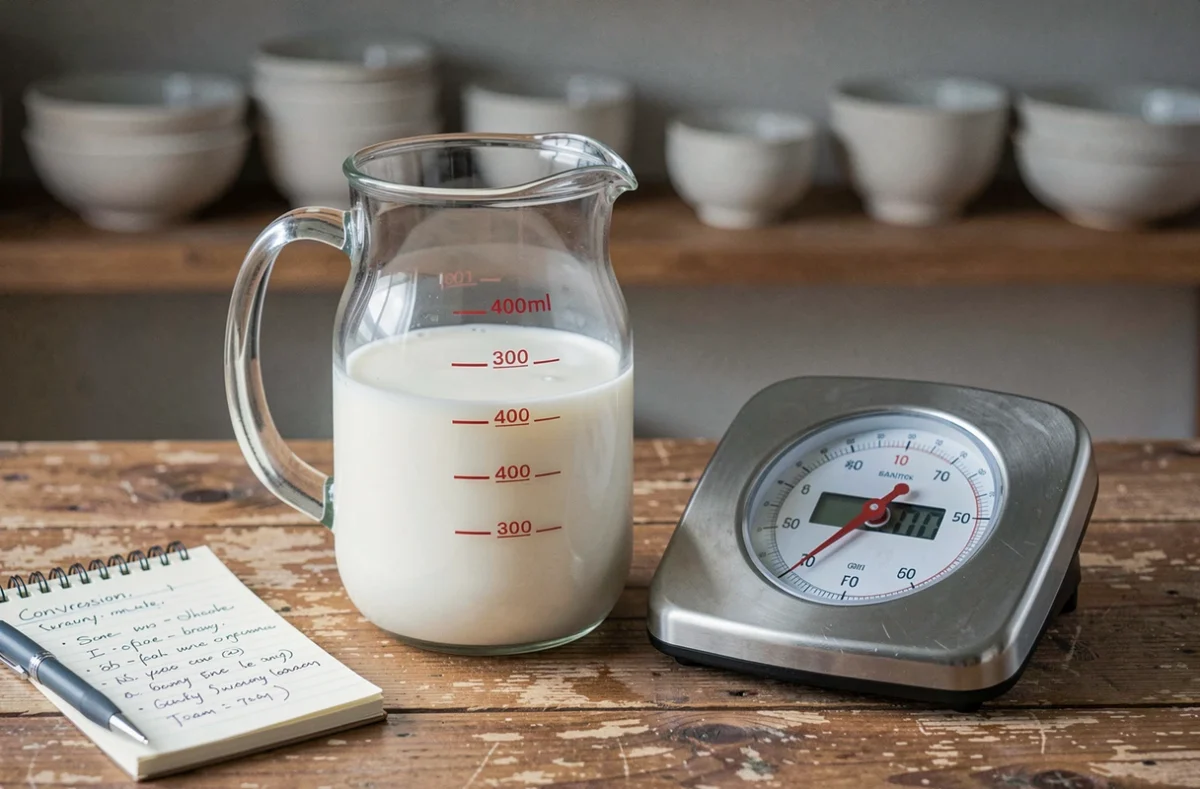
The scale remains the most reliable tool. Pouring the milk into a container placed on a kitchen scale and aiming for 410-412 g eliminates any approximation related to the container.
Why the Difference with Water Matters in Pastry
In savory cooking, a difference of 12 g of liquid goes unnoticed in a soup or sauce. In pastry, the situation is different. Recipes for flan, set cream, or panna cotta rely on a precise balance between gelling agent and liquid. Adding 400 g of milk instead of 412 g alters the ratio, and the final result is affected: too firm a texture, failed unmolding, consistency that does not set properly.
The same reasoning applies to other cooking liquids. Fresh cream, oil, and honey each have their own density, sometimes very different from that of water. Applying the rule 1 ml = 1 g to all liquids is a recurring source of error in precision cooking.

Summary Table: 40 cl Converted to Grams by Ingredient
This table allows for a quick comparison of the weight of 40 cl for the most common liquids in cooking:
| Ingredient | Approximate Density | 40 cl in grams |
|---|---|---|
| Water | 1.00 | 400 g |
| Whole Milk | 1.03 | 412 g |
| Semi-Skimmed Milk | 1.02 | 408 g |
| Liquid Cream | varies according to fat content | varies |
| Oil | lighter than water | significantly less than 400 g |
Oil is the classic trap: 40 cl of oil weighs significantly less than 40 cl of water. Confusing the two in a vinaigrette or oil cake recipe skews the proportions visibly.
Nutrition Labeling and Dual Volume-Mass Logic
Milk labels in France display nutritional values per 100 ml, in accordance with European regulations on consumer information. The Ciqual table from ANSES, the national reference for nutritional composition, expresses its data per 100 g of product. This dual volume/mass labeling creates frequent confusion when recalculating caloric intake from a volume measured in centiliters.
Knowing that 40 cl of milk corresponds to 412 g (and not 400 g) allows for correctly recalculating nutritional intake without underestimating the calories, proteins, or calcium actually consumed.
The next time a recipe calls for 40 cl of milk and the scale is the only available tool, aiming for 410 to 412 g rather than 400 g is enough to correct the approximation. A simple gesture, which relies on just one number: 1.03.